

We often think of our homes as personal sanctuaries, but the air we breathe inside can be surprisingly unhealthy. In fact, it's often more polluted than the air outside. The good news is, achieving significant indoor air quality improvement is entirely achievable, blending simple habits with smart ventilation technology.
This guide provides practical, actionable insights for homeowners, builders, and commercial clients. It's less about a single quick fix and more about a consistent approach to reducing airborne pollutants and bringing in a steady stream of fresh, clean air.
Why Your Home's Air Might Be Unhealthy
So, where do these indoor pollutants come from? Many are released by common household items and daily activities, often without us even realising it.
New furniture, carpets, and a fresh coat of paint can release chemicals known as Volatile Organic Compounds (VOCs) for weeks or even months. Even something as routine as cooking on a gas hob can introduce nitrogen dioxide and carbon monoxide into your kitchen. If that air has nowhere to go, those pollutants simply build up.
The Invisible Culprits in Your Home
Damp and mould are another major issue, especially in poorly ventilated bathrooms, kitchens, and utility rooms. They release microscopic spores into the air that are notorious for triggering allergies and respiratory problems.
Ironically, our drive for energy efficiency has made things worse in some ways. Modern homes are built to be incredibly airtight, which is fantastic for keeping heat in and energy bills down. The downside? That same airtight seal traps pollutants inside, creating a cocktail of contaminants that we breathe in day after day.
The health implications are serious. A landmark report from the Royal College of Physicians estimated that air pollution—including inside our homes—contributes to around 30,000 deaths annually in the UK. The research links this toxic air to a frightening range of conditions, from cancer and heart disease to dementia.
This highlights the critical need for effective indoor air quality improvement. The challenge is to maintain that prized energy efficiency while ensuring the air we live with is fresh and healthy.
This is where advanced systems come into play. Mechanical Ventilation with Heat Recovery, or MVHR, is a game-changing solution designed for modern, airtight homes. It works by continuously extracting stale, moist air and replacing it with filtered fresh air from outside. The clever part is that it recovers the heat from the outgoing air, using it to warm the incoming fresh air. This means you get a constant supply of clean air without sacrificing your home's warmth or energy efficiency.
To get a better sense of the technology, you can find a full breakdown in our guide on what is heat recovery. For homeowners, self-builders, and commercial clients, understanding these invisible threats is the first step toward creating genuinely healthier buildings.
Simple Fixes for Better Air Today

While a high-tech ventilation system is the ultimate goal, you don’t need to wait for a major renovation to start breathing cleaner air. Some of the most effective changes are surprisingly simple and cost next to nothing. The real secret to immediate indoor air quality improvement is what we call source control.
It’s a straightforward idea: stop pollutants from getting into your air in the first place. For instance, next time you’re redecorating, don't just grab any old tin of paint. Make a conscious choice to look for brands labelled as "low-VOC" or "zero-VOC". These products release significantly fewer harmful chemicals.
The same goes for your cleaning cupboard. Many common household cleaners are packed with harsh chemicals that can hang around in the air long after you’ve put them away. Switching to natural alternatives or products with simple, recognisable ingredients is an easy win for reducing the chemical cocktail in your home.
Build Healthy Habits for a Healthier Home
Often, the biggest improvements come from small, consistent actions. One of the most powerful habits you can adopt is using your extractor fans properly.
Every time you cook, switch on the kitchen fan. Every time you shower, turn on the bathroom fan and—this is the important part—leave it running for another 15-20 minutes after you’re done. This simple act pulls damp, fume-filled air directly outside before it has a chance to spread, helping to prevent damp, mould, and lingering smells.
Another game-changer is the daily "airing out" routine. Just opening windows on opposite sides of your house for 5-10 minutes a day creates a cross-breeze. This quick flush pushes out stale, polluted air and pulls in fresh air from outside.
This regular air exchange is one of the fundamentals of a healthy home environment. You can explore the science behind it in our guide to the benefits of ventilation in homes.
Your Quick-Win Checklist
Ready to make a difference right now? Here are a few practical things you can do today.
- Dust with a Damp Cloth: A dry duster just sends particles airborne. A damp microfibre cloth actually traps and removes dust and allergens from surfaces.
- Keep an Eye on Humidity: Try to keep your home's humidity between 30% and 50%. A simple hygrometer can help you monitor levels and stop the damp conditions where mould and dust mites thrive.
- Get Some Green Help: Certain houseplants, like Spider Plants and Peace Lilies, are well-known for their ability to filter common airborne toxins.
- Wash Bedding on a Hot Cycle: Washing sheets and duvet covers in a hot wash every week is a brilliant way to kill off dust mites and remove allergens.
- Ditch the Shoes at the Door: Your shoes track in everything from pesticides to pollen. A simple "no shoes inside" rule keeps those pollutants out of your living space.
Putting these strategies into practice gives you immediate control over your home's health. They form the essential foundation that supports any larger ventilation system you might install later, including advanced solutions like heat recovery ventilation.
The Airtightness and Fresh Air Dilemma
We've made incredible strides in building energy-efficient homes. Pushed by standards like Part L compliance, the modern house is often a fortress of airtightness, brilliantly sealed to lock in heat and keep energy bills low. It's a massive win for homeowners and the planet, but it creates a paradox.
https://www.youtube.com/embed/VcDjyxanOyk
When you seal a home up that tightly, how do you keep the air inside fresh without letting all that precious heat escape? An airtight home without a solid ventilation strategy can quickly become a box for stale, polluted air.
Everyday life releases contaminants. Cooking, cleaning, showering, and even just breathing pump moisture, CO2, and VOCs into your home's atmosphere. In an old, draughty house, this would find its way out through gaps. In a modern, sealed home, it has nowhere to go, leading to a noticeable drop in indoor air quality. This is where you see problems with condensation, mould, and smells that just won't shift.
How Airtightness Affects Building Performance
For anyone in the building trade, getting this balance right is non-negotiable. A new build's performance is measured using SAP calculations (Standard Assessment Procedure), its energy efficiency report card. An airtight building scores very well, but if the ventilation isn't up to scratch, it can fail to meet other crucial regulations, like Part F for Ventilation.
This is where you really see the difference between ventilation strategies. For years, the standard approach was passive ventilation.
- Trickle Vents: Those little slots in window frames meant to let in a small flow of air.
- Extractor Fans: Intermittent fans in kitchens and bathrooms, designed to remove moisture and odours at the source.
These methods are better than nothing, but for a truly airtight home, they often fall short. Opening a window provides fresh air, but you're also watching your heating bill go up as your system fights to replace the lost warmth. And most people close their trickle vents the second they feel a draught, defeating the purpose.
The real issue is that passive ventilation is uncontrolled. It doesn’t balance the air coming in with the air going out, and it certainly doesn't recover any of the heat you're losing. In an age where we're chasing peak energy efficiency, it feels like an outdated fix.
Active Ventilation: The Modern Solution
The answer to the airtightness puzzle lies in active mechanical systems. Unlike passive methods, a mechanical system actively takes charge of the air exchange. The most sophisticated of these is Mechanical Ventilation with Heat Recovery (MVHR).
An MVHR system is engineered to work in perfect sync with an airtight building. It uses two sets of fans: one pulls stale, humid air from "wet rooms" like kitchens and bathrooms, while the other supplies fresh, filtered air to living rooms and bedrooms. The real magic happens inside the heat exchanger.
As the warm, stale air is extracted, it flows past the incoming fresh air (without mixing) and transfers its heat. A good system can recover up to 90% of the thermal energy. The result? You get a continuous supply of pre-warmed, clean air, which transforms your indoor air quality without the massive energy penalty.
For anyone building an energy-efficient home or retrofitting an older one, this technology is key. You can dig deeper by reading our post covering the benefits of an air tight home when you have the right ventilation partner.
How MVHR Systems Create Healthy Homes
We've seen how modern, energy-efficient homes can become so airtight that they trap stale air inside. This is the exact problem that a Mechanical Ventilation with Heat Recovery (MVHR) system is designed to solve. Think of it less as a fan and more as a complete breathing system for your entire house.
An MVHR unit works with two separate air streams. One is dedicated to pulling stale, damp air from the 'wet rooms' – your kitchen, bathrooms, and utility room.
At the same time, a second air stream draws fresh, clean air in from outside. Before this air is circulated into your living spaces and bedrooms, it’s passed through high-grade filters that catch dust, pollen, and other pollutants.
The Magic of Heat Recovery
Here's the clever bit: the heat exchanger. As the warm, stale air is on its way out, it passes through this exchanger right alongside the cool, fresh air coming in. The two streams never actually mix, but the technology is so effective that up to 90% of the heat from the outgoing air is transferred to the incoming fresh air.
This is why heat recovery ventilation is such a game-changer for energy efficiency. You get a constant supply of fresh, filtered air without the massive heat loss—and the sky-high heating bills—that come with just opening a window. It helps you maintain a comfortable, steady temperature indoors while keeping the air you breathe clean.
For a deeper dive into the technical side, our guide on how heat recovery ventilation systems work and why you need one breaks it all down.
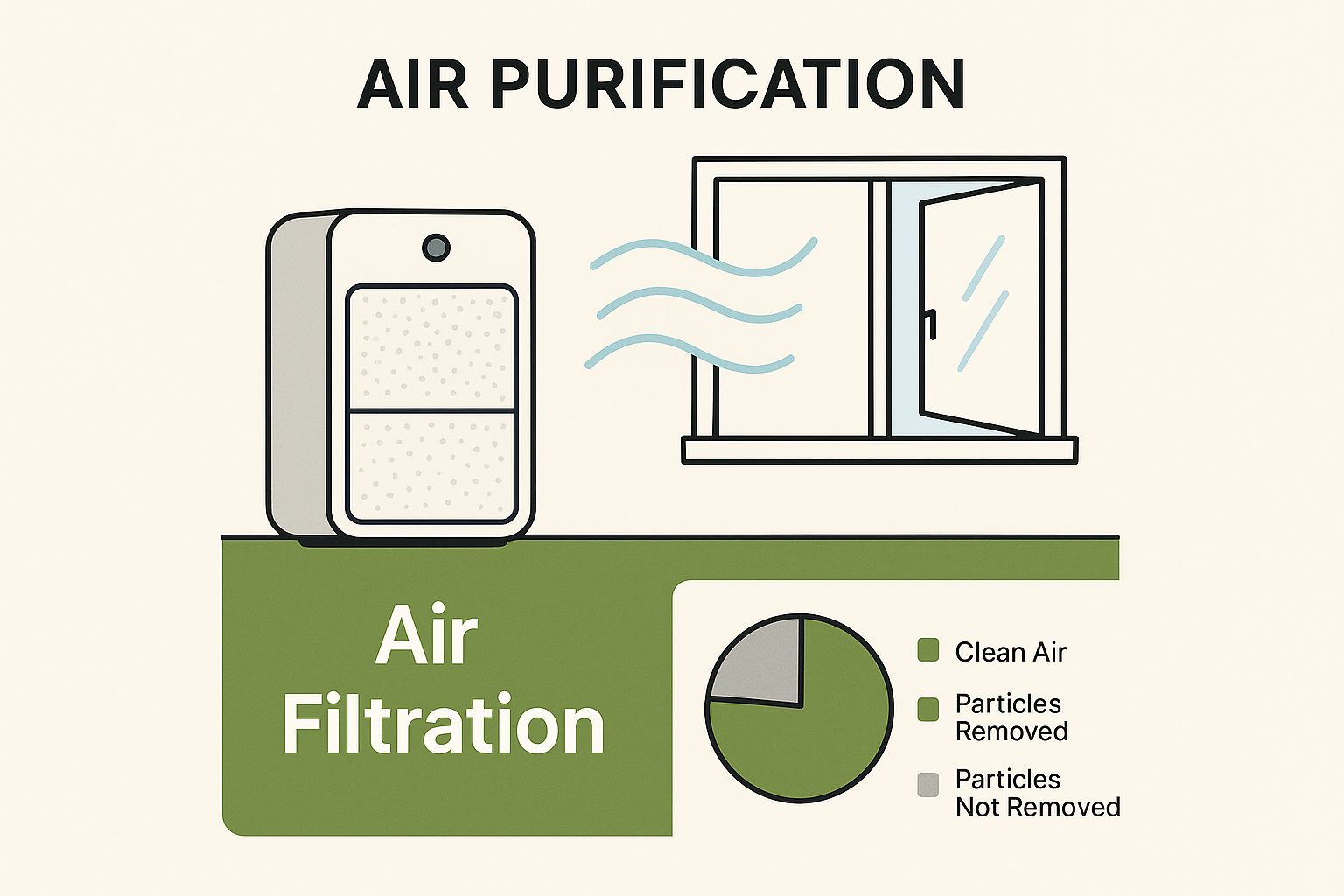
This image is a great reminder that improving indoor air quality is about more than just ventilation; it’s about actively filtering out pollutants.
Benefits Across The Board
The positive impact of an MVHR system is felt by everyone, from the family living in the house to the professionals who built it.
For Homeowners:
- A Healthier Home: With a constant flow of filtered air, you'll see a reduction in dust, allergens, and VOCs. This can be a huge relief for anyone with asthma or allergies. It also banishes condensation, stopping mould and damp.
- Better Comfort: No more stuffy rooms or lingering cooking smells. An MVHR system keeps your home feeling fresh all day long, without any chilly draughts.
- Lower Energy Bills: By recovering valuable heat, your heating system doesn't have to work as hard. The savings on your bills can be significant.
For Builders and Commercial Clients:
- Simplified Part F & L Compliance: For new builds and major renovations, fitting an MVHR system is one of the most reliable ways to meet strict ventilation and energy efficiency standards in today's building regulations.
- Improved SAP Calculations: A properly designed MVHR system gives a property’s energy performance rating a serious boost, making it far more appealing to buyers and increasing its value.
- A Unique Selling Point: You’re not just selling an energy-efficient building; you're offering a genuinely healthy one. In today’s market, that’s a powerful message that sets a property apart.
Why Professional Design Is Non-Negotiable
It’s tempting to think of an MVHR system as just another appliance, but it's a sophisticated network that needs to be perfectly integrated into the fabric of your home. A poorly designed or installed system won’t just underperform; it can create new problems like noise and poor airflow.
Professional design is absolutely critical. An expert will perform detailed calculations to determine the exact airflow needed for every room. They’ll select the right-sized unit and map out a ducting system that’s quiet, balanced, and highly efficient. This is the only way to guarantee the system delivers on its promise of optimal indoor air quality improvement and energy efficiency.
Trying to DIY an installation or hiring an unqualified person is a false economy. The difference in performance between a professionally commissioned system and a poorly fitted one is night and day.
Building a High-Performance Healthy Home

When we talk about genuine energy efficiency, it's easy to focus on saving money on bills. But a truly high-performance home is also healthy for the people inside it. This means taking an integrated approach, where indoor air quality improvement is a core part of sustainable building design.
The most effective strategy is a 'fabric-first' approach. Before we even think about technology, we focus on perfecting the building envelope itself. That means best-in-class insulation, high-performance windows, and, crucially, exceptional airtightness.
Once the building's fabric is doing its job of keeping heat in, a heat recovery ventilation system (MVHR) becomes the vital next piece. It ensures a constant supply of fresh, filtered air without undoing all that hard work on thermal efficiency.
A Cohesive System for Optimal Performance
Think of your home as a finely tuned machine. High-performance insulation and airtightness are the chassis, providing a stable interior. The MVHR system provides the sophisticated breathing apparatus—it acts as the lungs of the building.
The two elements work in perfect harmony. The airtight seal stops uncontrolled draughts and heat from escaping, while the MVHR system manages airflow with precision. It's this synergy that delivers both incredible energy efficiency and fantastic indoor air quality.
You can take this integrated system even further by incorporating other green technologies:
- Solar Panels: By adding solar panels to your roof, you can generate your own renewable electricity. This can power your MVHR unit and other appliances, slashing your reliance on the grid and shrinking your carbon footprint.
- High-Performance Glazing: Triple-glazed windows are the perfect complement to an airtight structure. They minimise heat loss, which allows the MVHR system to maintain a steady indoor temperature with very little effort.
This holistic view is essential for hitting today's demanding building standards, like Part L compliance and impressive SAP calculations.
The Financial Case for Clean Air
Viewing indoor air quality improvement purely as a health benefit is to miss half the story. It's also an incredibly smart financial move. Poor air quality has a tangible economic cost, leading to lost productivity and higher healthcare spending.
A landmark study in London’s Borough of Camden found that government subsidies for indoor air pollution monitors could generate annual savings of up to £40 billion. These savings would come from a healthier, more productive workforce and reduced NHS costs from fewer pollution-related illnesses.
This powerful research reframes the conversation. An MVHR system stops being an 'expense' and becomes a direct investment in the health and well-being of everyone in the building. For our commercial clients, that means a healthier team and fewer sick days. For homeowners, it means a healthier family and a more valuable, future-proofed home.
To reap these long-term rewards, the system needs to be properly maintained. Regular filter changes and professional check-ups ensure it operates at peak efficiency. To keep your system delivering clean air and energy savings, take a look at our professional MVHR system service packages.
Your Indoor Air Quality Questions Answered
When you start digging into ventilation and air quality, it's natural for questions to pop up. Let's walk through some of the most common queries with clear, practical answers.
How Can I Tell If My Home Has Poor Air Quality?
The clues are often right under your nose. Do cooking smells hang around for hours? Do you wake up to find condensation streaming down your windows? Does your home just feel a bit stuffy? These are all classic signs that your property isn't breathing properly.
For many people, the real lightbulb moment comes when health issues start to surface. Unexplained headaches, constant tiredness, or family members' allergies and asthma suddenly getting worse are often linked to what's in the air at home.
Is Opening Windows Enough for Good Ventilation?
Cracking open the windows for a quick blast of fresh air is a great habit. But as a long-term ventilation strategy, it falls short, especially in modern homes. It's an all-or-nothing approach – you get fresh air, but you also get outdoor noise, pollen, and pollution.
The biggest issue is how it undermines your home’s energy efficiency. Every time you open a window on a cold day, the warm air you've paid to heat rushes straight out. An MVHR system, on the other hand, gives you a constant, controlled flow of fresh, filtered air without that massive energy penalty.
Will An MVHR System Make My House Cold?
This is probably the biggest misconception we come across, and the answer is a firm no. In fact, it's quite the opposite. The "heat recovery" part of the name is the key.
A quality MVHR system is incredibly efficient, capturing up to 90% of the heat from the stale air it extracts. It then uses that captured warmth to pre-heat the fresh air it brings in. The result? No cold draughts, just a comfortable and stable temperature throughout your home, all year round.
Does An MVHR System Need a Lot of Maintenance?
MVHR systems are designed to be low-maintenance. The main job for any homeowner is checking the filters every three to six months and cleaning or replacing them as needed. It’s a five-minute task that keeps the system running smoothly.
Beyond that, we always suggest getting a professional service every one to two years. This is a routine check-up to make sure everything is balanced, quiet, and working at peak efficiency. It’s a small step that protects your investment and ensures clean, healthy air for years to come.
Can I Retrofit an MVHR System Into My Existing Home?
Yes, you absolutely can. While it’s most straightforward to plan for an MVHR system in a new build or during a major renovation, retrofitting is a very popular option.
The main puzzle to solve in a retrofit is figuring out where to run the ductwork with the least disruption. Our design team has extensive experience finding clever, discreet routes for ducting in existing properties. It means you can get all the benefits of heat recovery ventilation, even as part of achieving Part L compliance in a major refurbishment.
Ready to transform the air in your home or project? For expert advice on designing the perfect heat recovery ventilation strategy, get in touch with the team at Heat Recovery Direct.
Contact us today to discuss your project and take the first step towards a healthier, more energy-efficient building.